
Why Search Console and GBP belong in the same weekly review
Organic and local signals drift apart when nobody connects the dots. One rhythm—and one view of GSC plus Google Business Profile—fixes the story you tell and the work you prioritize.
 Run Your Free SEO Scan →
Hero visual contrasting chaotic, disconnected Google tool icons with a simplified path that merges website query performance from Search Console with Google Business Profile visibility signals. Frames the article’s core idea: one weekly review habit for both channels.
If you run local SEO for a small business—or juggle ten SMB clients as an agency—you already live in Google’s ecosystem. Search Console shows how your website earns queries and clicks. Google Business Profile (GBP) shows how you show up in Maps, the local pack, and branded local searches. The problem is not a lack of data. It is that most teams review them on different days, in different tabs, with no shared story.
This post explains why Google Search Console and GBP belong in the same weekly (or biweekly) review, what to look at in each, and how to combine them without buying five separate local SEO tools. We will also touch on keyword rank tracking and review momentum—because local visibility is never only “website SEO” or only “the listing.”
Why organic rankings and local visibility drift apart
Website SEO work shows up in Search Console: impressions, average position, clicks, and coverage. GBP performance shows up as views, searches, actions, and direction requests. When those two trend lines diverge, leadership hears conflicting narratives: “Traffic is up” while “the phone is quiet,” or the opposite.
Often the gap is simple. You may rank for informational queries that never convert locally. Or your Maps presence is strong while your site fails to capture branded or high-intent traffic. A Google Search Console reporting habit without a GBP check—or the reverse—makes it easy to optimize the wrong thing for a full quarter.
What to pull from Search Console each week
Search Console is your ground truth for how Google connects searchers to your site. For a tight weekly review, focus on a small set of views:
- Performance: top queries and pages by clicks and impressions—especially queries that include your city, neighborhood, or “near me” modifiers.
- Coverage and page indexing: new errors or “Discovered – currently not indexed” spikes after a launch or template change.
- Core queries stuck on page two: pages that already get impressions but not clicks—the fastest wins often live here.
You do not need enterprise SEO software to do this. You need a repeatable filter: which queries map to revenue (or leads) this month, and which pages support them? That question pairs directly with what you see on the Maps side.
What to pull from Google Business Profile in the same sitting
GBP answers a different question: are people discovering and choosing your business in local contexts—Maps, Search’s local pack, and direct brand lookups? In the same weekly block, scan:
- Search breakdown: branded vs discovery searches—if discovery is flat while site traffic rises, your listing may need categories, photos, or services updates.
- Actions: calls, directions, and website taps—are they trending with your seasonality?
- Photo and post cadence: when did you last add proof-of-work, offers, or FAQs customers actually ask?
Google Business Profile optimization is not a one-time checklist. It is a rhythm: small updates, steady reviews, and alignment with what Search Console says people actually type.
The weekly rhythm: one dashboard, one story
The fix is operational, not technical. Block thirty to forty-five minutes. Open Search Console and GBP together—or use local SEO software that surfaces both so you are not logging into four tabs. Name the single story for the week: for example, “We are winning informational queries but losing high-intent local clicks,” or “Maps is strong; the site is not capturing branded follow-up.”
Agencies reporting to SMB clients especially benefit from this combined narrative. Clients do not want a spreadsheet export from one tool and a PDF from another. They want one clear explanation of what changed, what you did, and what you will do next—which is exactly what all-in-one SEO platforms try to preserve.
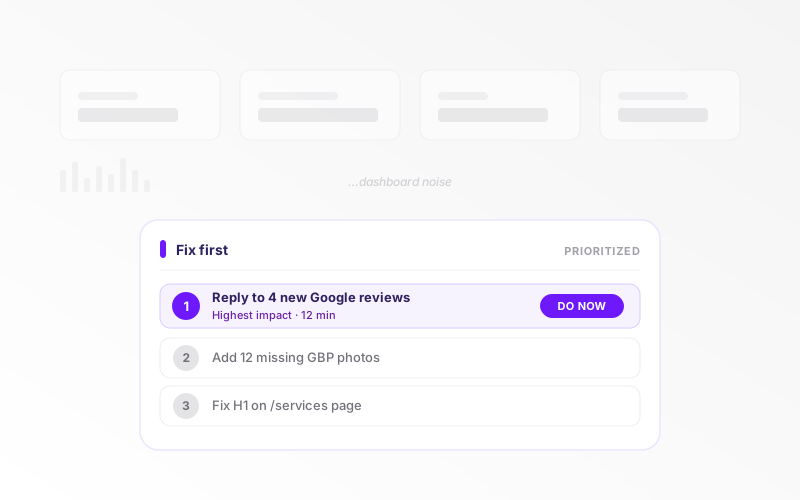
Line-style graphic showing multiple inputs converging into one ordered workflow. Supports the section on combining Search Console checks with Google Business Profile updates in a single prioritized list rather than many browser tabs.
Keyword rank tracking and local intent
Search Console shows aggregate query performance; it is not a full local rank tracker for every grid point or competitor map pin. Many teams add keyword rank tracking for a short list of money terms—commercial keywords, service + city pairs, and priority product names. The point is not daily anxiety-checking every variation. It is tying rank movement to the same weekly review where you already look at GBP actions and GSC clicks.
When a priority keyword slips, ask: Is the site weak (content, technical, internal links), or is the local entity weak (reviews, categories, relevance to that service area)? Answering that split is much easier when Search Console and GBP data sit side by side.
Reviews: the third leg of the same stool
Review velocity and response time influence trust and local engagement. You do not need to paste review charts into the same spreadsheet as GSC—but you should know whether reviews sped up or stalled while traffic moved. If impressions rise and conversions lag, a thin review profile or slow replies is a common culprit. Review request automation and AI-assisted reply drafts exist to keep that leg of the stool from breaking while you focus on technical SEO.
A practical agenda: your combined weekly checklist
- Search Console: top 10 queries by clicks; flag any local or commercial query down more than one week.
- Search Console: one page stuck on page two with real impressions—pick the fix (title, intent match, internal link, or snippet).
- GBP: actions vs prior week; note calls or directions drops.
- GBP: one profile improvement (new photo, service tweak, post, or Q&A).
- Optional: check your tracked keyword set for the top five money terms.
- Write one sentence for stakeholders: the single story of the week.
What to look for in local SEO software
If you are evaluating a local SEO tool for small business or agency use, prioritize products that reduce context switching: Google Search Console reporting next to GBP metrics, clear prioritization of fixes, and room to grow into keyword rank tracking and review workflows. The best stack is the one your team actually uses every Monday—not the one with the longest feature matrix.
RankStream is designed for that combined workflow: website SEO audits, GBP insights, Search Console context, keyword intelligence, and review growth in one login—so your weekly review matches how search actually works for local businesses.
Mistakes that keep teams stuck in silos
- Reviewing GSC only after major algorithm chatter instead of on a fixed cadence.
- Treating GBP as “set and forget” after verification.
- Reporting website metrics to local owners without ever showing Maps actions or calls.
- Chasing blog volume when the local pack for core services is still uncompetitive.
Bottom line
Search Console and Google Business Profile answer different questions, but they describe one business on one search results page. Putting them in the same weekly review—supported by light keyword rank tracking and honest review cadence—is how SMBs and agencies stop optimizing in circles. You do not need more dashboards; you need one habit that connects them.
If you want that habit built into the product, explore RankStream’s plans and see how teams combine audits, local signals, and reporting without the usual tool sprawl.


